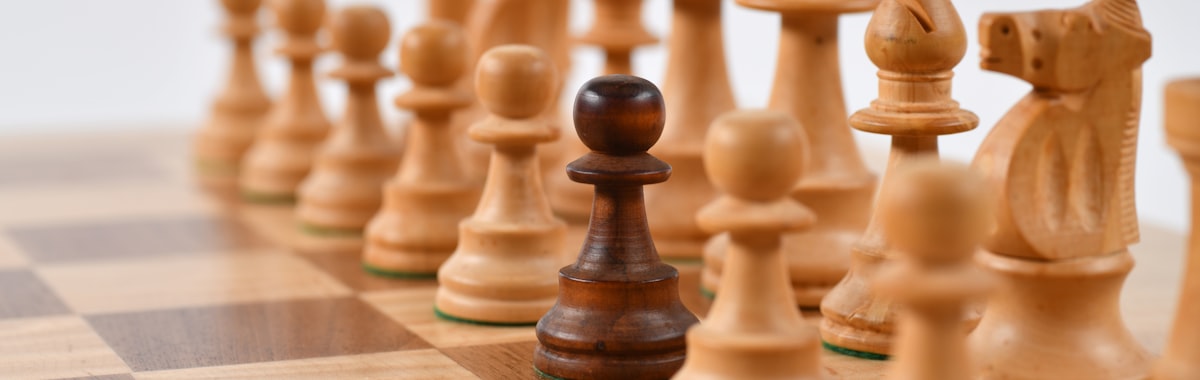
I'm a rated rapid chess player, and I've been serious about the game for years — studying openings, pattern recognition, endgames, and the mental side of competition. I've also spent time in high-level competitive gaming, including coaching and managing an esports team through a world-championship run. Different games, one common thread: reading the position, thinking several moves ahead, and staying calm when it counts.
As a teacher, I lean practical: less memorization, more understanding of why moves work — so what you learn holds up when a game leaves your preparation. And I genuinely love teaching. There's nothing quite like the moment a student sees a position differently than they did before.
Chess is the archetype of the thinking I teach everywhere else. The skill that lets a kid picture three moves ahead on the board is the same one that lets an adult think clearly about a hard problem — same skill, different board. If that idea resonates, the mentorship page shows how it extends beyond chess.
Who I work with
From a first-ever game to breaking through a rating ceiling, the work changes with the player:
Complete Beginners
Never played before? Perfect. We start with how the pieces move and build from there — with real games from the first session, not just drills.
Kids & Teens
Patient, encouraging lessons for young players — building focus, planning, and confidence through a game they'll actually enjoy. Parents kept in the loop, and welcome to sit in.
Intermediate Players
Stuck around 800–1400? We'll diagnose where your games are actually being lost — usually not where you think — and fix that specifically.
Strategic Thinkers
Chess is one of the best tools I know for building patience, focus, and the ability to think several steps ahead. Great for professionals, students, and anyone wanting a sharper mind.
What lessons look like
There's no fixed curriculum — every lesson is shaped by your specific gaps and goals. Most sessions draw on a mix of:
- Game review — We go through your recent games and find the patterns in your mistakes. Most improvement comes from here.
- Opening preparation — Building a reliable, principled opening repertoire suited to your style.
- Tactical training — Pattern recognition drills: forks, pins, skewers, discovered attacks. These are the building blocks of middle-game play.
- Endgame fundamentals — Often the most neglected area. Knowing basic endings saves games that look lost.
- Live play & analysis — Playing games together with real-time commentary, then breaking them down afterward.
Format & logistics
Lessons are one-on-one, either in person in San Francisco (Duboce Triangle) or online via screen share. Sessions are typically 60–90 minutes. Frequency is flexible — weekly is ideal for steady improvement, but bi-weekly or one-off deep dives work too.
You don't need to bring anything but curiosity — no equipment, no prior study, no minimum rating. And as with everything at Wallace & Friends, accessibility for diverse communities, including neurodiverse individuals, is built in: pacing, format, and materials all adapt to how you learn best.
Two easy ways to start
Nothing to lose by reaching out — for yourself or your child.
Your first lesson is free
Every new client's first lesson is free — we'll play a little, talk about what you'd like to get from the game, and find the right starting point, with no obligation to continue. Book a free lesson →
50% off when you're referred
New clients referred by someone we already work with get 50% off their first engagement — our thanks to both of you.
Chess taught me how to lose well — which turns out to be one of the most useful skills in any domain. I try to pass that on to every student.
Tell me where you are with the game and what you'd like to get from it — we'll figure out the right starting point together.